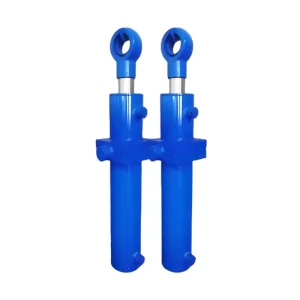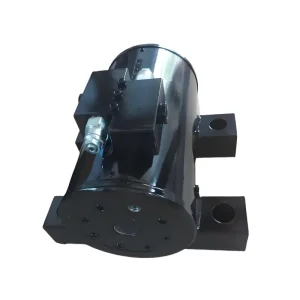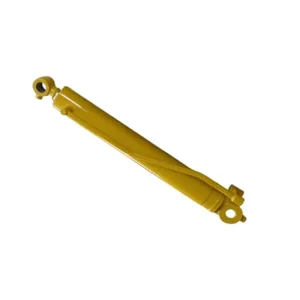
Featured Machinery, Components & Workholding Units
Explore our top-tier precision hydraulic assemblies, custom-machined end-closures, and high-rigidity CNC tool-holding modules manufactured in Qingdao for heavy-industry duty cycles.
Engineering Architecture of ODM Cylinder Head Machine Systems
A granular examination of multi-axis machining centers, tight-tolerance rod guidance boring, and dynamic sealing integration for next-generation heavy fluid-power actuators.
Sub-Micron Concentricity Boring
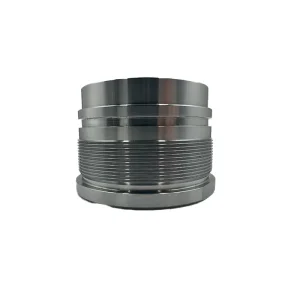
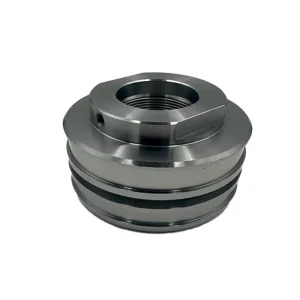
In hydraulic actuation, the cylinder head (or cylinder gland) functions as the critical end-closure that seals high pressure, guides the reciprocating piston rod, and houses secondary wiper and step-seal systems. Any geometric runout between the inner rod bore and outer barrel-locating spigot causes accelerated, uneven seal wear and catastrophic rod galling.
Our ODM cylinder head machining process executes both pilot spigots and internal bushing guide bores in a single clamping setup using high-rigidity CNC turning centers. This process yields strict concentricity tolerances under 0.015 mm (15 μm), directly ensuring maximum seal longevity across intense 35 MPa cyclic pressures.
Optimized Seal-Groove Geometry
Hydraulic sealing grooves demand exact dimensional and surface finish execution. Rough micro-grooves degrade elastomer backing rings, while sharp internal corners concentrate dynamic hydraulic fatigue. Our specialized grooving cycles utilize internal forming cutters configured with exact nose radii to eradicate stress risers.
Surface finishes inside dynamic wiper, rod buffer, and secondary U-cup cavities are maintained at Ra 0.2 to Ra 0.4 μm. This micro-finish minimizes boundary friction during dry start conditions and prevents extrusion bypass even under sudden shock spikes.
Structural Material Metallurgy
Machining high-integrity cylinder heads demands structural reliability. We source premium ductile cast irons (QT500-7, QT600-3) and forged alloy steels (42CrMo4, 40Cr, AISI 1045). Spheroidal graphite iron delivers exceptional self-lubricating characteristics and vibration damping for high-frequency loader linkages.
For underground mining and heavy crane outriggers subjected to severe tensile impulse loads, forged alloy steels are heat-treated to 28-32 HRC prior to CNC operations, preventing thread deformation under intense burst-pressure ratings.
Global Fluid-Power Landscape: Shift Toward Modular ODM Sourcing
Tier-1 heavy equipment manufacturers in North America, Western Europe, and the Asia-Pacific region are transitioning from legacy captive machining to specialized, contract-engineered component manufacturing.
Total Cost of Ownership (TCO) Optimization
In-house machining of hydraulic cylinder heads requires dedicated CNC multi-axis horizontal boring mills, specialized internal thread tapping tooling, coordinate measuring machines (CMM), and continuous tooling changeovers. OEMs operating dedicated lines often experience high overhead during cyclical market lulls.
Partnering with an ODM specialist allows Western equipment builders to transition heavy capital expenditure (CapEx) into flexible operational expenditure (OpEx), reducing finished component costs by 22% to 35% while maintaining identical or superior metallurgy and GD&T fidelity.
Geographic Demand Vectors
North America: Accelerated infrastructure investment and non-residential construction require durable machinery capable of operating under heavy contamination and variable climatic swings.
Western Europe: Strong regulatory pressure toward energy efficiency and minimal environmental contamination demands near-zero micro-leakage cylinder heads and integrated counterbalance manifold cavities that avoid external high-pressure hosing.
Emerging Markets (APAC & LATAM): Rapid expansion of open-pit mining and mechanized agriculture requires heavy-duty components capable of tolerating poor-quality fluid maintenance and dynamic shock spikes.
The Modular Manufacturing Paradigm
Modern mobile machinery builders increasingly demand integrated modular end-closures. Rather than assembling a discrete cylinder head, threaded port adapter, separate counterbalance block, and mechanical lock valve, our factory engineers consolidated, single-block head solutions.
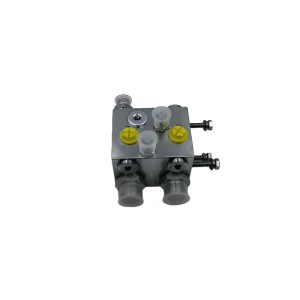
By machining the hydraulic port cavities, valve cavities (counterbalance / pilot-operated check valves), and cushion sleeves directly into the forged head body, external leakage paths are reduced by up to 70%.
Qingdao Manufacturing Velocity & Vertical Supply Chain Resilience
Harnessing advanced manufacturing ecosystems to deliver unmatched component throughput, metallurgical tracing, and rapid ODM turnaround times.
Localized Metallurgical Cluster
Our facility in Chengyang District, Qingdao, operates within China's primary fluid power and heavy engineering corridor. Shandong Province produces a substantial portion of global high-grade ductile casting, structural seamless cold-drawn steel tubes, and forged alloy blanks.
Raw material lead times are measured in hours rather than months, buffering our operations against global commodity fluctuations and ensuring uninterrupted component feedstocks even during peak industrial production seasons.
In-House Turnkey Processing
Unlike trading intermediaries that subcontract machining steps across fragmented job shops, Qingdao Micro Precision Machinery maintains complete internal operational sovereignty. We govern drawing validation, CNC rough turning, induction hardening, precision 5-axis finish boring, internal thread milling, ultrasonic deburring, and ISO class cleaning.
This complete vertical integration avoids multi-tier markups and prevents production bottlenecks, maintaining our established monthly capacity of 20,000 precision fluid-power units.
Deep-Water Logistics Gateway
Located minutes from the Port of Qingdao—one of the world's premier container logistics hubs—our export workflow avoids internal transit delays and minimizes drayage costs. Finished components undergo automated VCI anti-corrosion barrier wrapping, desiccated vacuum sealing, and heavy-timber ISPM 15 certified export packaging.
Containers clear customs on-site, offering direct container vessels to European and North American gateway ports within reliable schedules.
Localized Application Scenarios & Severe-Duty Deployment
Our machined cylinder heads, valves, and precision actuators operate inside the world's most unforgiving commercial machinery environments.
Underground Mining LHDs
Operating hundreds of meters below surface level, Load-Haul-Dump vehicles endure constant corrosive mine runoff, abrasive silicate dust, and severe breakout shock loads. Lift cylinder heads utilize high-tensile nodular iron housings fitted with composite guide rings and dual bi-directional step-seals.
These engineered seals handle extreme rod flexure without oil bypass or contamination ingress, maintaining mine safety standards.
Reversible Agricultural Ploughs
Modern agricultural turnover cylinders operate under continuous multi-axis rotational shear. Our customized cylinder heads integrate internal hydraulic cushion check valves that decelerate heavy plough frames near the stroke terminal points.
This deceleration eliminates dangerous chassis shock during high-speed field turning operations, protecting tractor three-point linkages from metal fatigue.
Heavy Construction Excavators
Boom, stick, and bucket actuation cycles run continuously across 12-hour shifts. Piston rod velocities reach up to 1.5 m/s under pressure spikes up to 40 MPa.
Our forged steel heads MPM-HCHD11 incorporate precision-machined end-cushioning throttles. These throttles trap fluid at the stroke limits to create controlled pressure rises, cutting vibration and noise by up to 18 dB on job sites.
Aerial Platforms & Mobile Cranes
Personnel safety demands zero hydraulic pressure drop. Cylinder heads for aerial boom lifts integrate our proprietary T3A counterbalance valve cavities directly into the head block.
In the event of an external hydraulic supply line rupture, the internal poppet seats within under 15 milliseconds, mechanically locking the extension rod and preventing platform descent.
Technology Roadmap (2025–2030): The Intelligent Cylinder Head Machine Cell
Advancing from conventional multi-axis machining toward automated, closed-loop metrology and smart fluidic monitoring systems.
Automated Closed-Loop In-Line Metrology
Deploying machine-vision sensors and spindle-mounted contact probes within horizontal machining cells. Dimensions of critical seal grooves and rod bore diameters are measured before part unclamping.
Any thermal drift or tool deflection triggers automated CNC tool-wear offset updates, maintaining stable Cpk values > 1.67 across large production runs.
Integrated Sensor Head Architecture
Machining internal sensor ports designed for embedded magnetostrictive and Hall-effect position transducers directly into cylinder heads.
This layout shields sensitive instrumentation inside the forged steel head assembly, providing real-time stroke position, oil temperature, and vibration telemetry for autonomous construction equipment.
Cryogenic Machining & Micro-Finishing
Transitioning to supercritical CO2 and liquid nitrogen minimum quantity lubrication (MQL) during tough alloy (42CrMo4) turning and threading.
Cryogenic cutting lowers cutting interface temperatures, preventing surface micro-cracks and extending tool life by 200% while reducing coolant disposal impacts.
Digital Twin & Automated Batch Customization
Direct integration between customer CAD models and our CAM programming software. 3D models feed into automated toolpath generation, collision verification, and automated guided vehicle (AGV) scheduling.
This digital pipeline compresses custom prototype cycles down to just 5 working days from engineering sign-off.
Technical Compliance, Geometric Standards & Quality Verification
Every component manufactured by Qingdao Micro Precision Machinery complies with rigorous international manufacturing codes and fluid-power specifications.
| Inspection Dimension / Domain | Applicable Global Standard | Guaranteed Quality Parameter | Quality Verification Method |
|---|---|---|---|
| Cylinder Fastener Threads | ISO 965-1 / ISO 68-1 | Thread Class ISO 6H tolerance | Precision Optical Profile Projector & Go/No-Go Gauges |
| Sealing Gland Surface Micro-Finish | ISO 4287 / ASME B46.1 | Ra 0.2 – 0.4 μm / Rz ≤ 1.6 μm | Diamond-Stylus Contact Surface Profilometer |
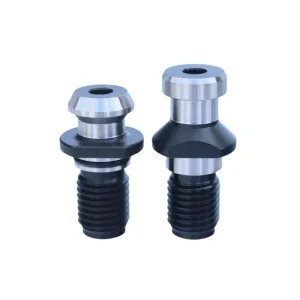
| CNC Tooling Pull-Studs | DIN 69872 / JIS B6339 | Core Hardness 56 – 60 HRC | Digital Rockwell Hardness & Magnetic Particle Inspection |
| Geometric Runout & Concentricity | ISO 1101 (GD&T) | Bore-to-Spigot runout ≤ 0.015 mm | High-Precision 3D Coordinate Measuring Machine (CMM) |
| Pressure Retaining Integrity | ISO 10100 / ISO 19973 | 1.5× Working Pressure (to 63 MPa) | Automated Hydrostatic Test Stand with Burst-Burst Data Logging |
| Corrosion Protection for Ocean Freight | ASTM D1748 / MIL-PRF-16173 | Zero corrosion post-720hr Salt Spray | VCI Protective Packaging & Vapor-Proof Barrier Enclosures |
Frequently Asked Technical & Sourcing Questions (FAQ)
Clear, direct answers from our engineering and manufacturing teams to simplify your cross-border supply chain decisions.
To provide an exact engineering quote within 24 hours, our team requires: (1) Cylinder bore and piston rod diameters; (2) Maximum continuous operating pressure and peak shock load envelope (e.g., 25 MPa continuous / 40 MPa peak); (3) Connection interface method (threaded head, bolt-circle flange, or integrated retention collar); (4) Specified seal profiles (step-seals, U-cups, buffer rings, or scraper preferences); (5) Base metallurgy specifications (such as QT500-7 nodular iron or 42CrMo forged alloy steel); and (6) Projected annual production volume. 2D dimensioned PDF drawings, step 3D CAD models, or physical samples facilitate rapid processing.
When reverse-engineering legacy or aftermarket cylinder heads, our inspection lab performs a multi-stage audit: (1) High-resolution 3D optical scanning to map exterior profiles and port geometries; (2) Internal coordinate measuring machine (CMM) probing to evaluate seal groove depths, lead-in chamfer angles, and guide bushing tolerances; (3) Spectrometric material composition testing to determine exact alloy and carbon levels; and (4) Rockwell micro-hardness testing to assess heat-treatment depth. An engineering CAD approval drawing is submitted for customer sign-off prior to batch production, ensuring drop-in dimensional compatibility.
Yes. Our CNC multi-axis turning and machining centers regularly machine all global hydraulic port geometries, including Metric ISO 6149-1 (O-ring boss), SAE J1926-1 / MS-16142 (UN/UNF threads with O-ring seals), British Standard Pipe Parallel (BSPP / ISO 1179), and NPT pipe threads. Internal threads are cut using multi-flute carbide thread-milling tools rather than taps, preventing burr generation and guaranteeing clean, repeatable thread forms compliant with ISO 6H or ANSI 2B specifications.
For severe corrosive conditions, we apply tailored anti-corrosion treatments: (1) High-density zinc nickel (Zn-Ni) electroplating offering over 720 hours of salt spray resistance (ASTM B117) without red rust formation; (2) Black oxide and manganese phosphate coatings for enhanced lubricity and intermediate atmospheric shielding; (3) Multi-coat marine-grade polyurethane paint finishes tailored to customer RAL color codes; or (4) Direct precision machining from 316L stainless steel for marine, chemical, or subsea valve bodies.
For custom engineered prototypes and initial sample batches, our average lead time is 15 to 21 calendar days from CAD approval, complete with full inspection documentation. For series OEM container orders (500 to 5,000+ units), regular lead times range from 30 to 40 days. Expedited batch schedules can be accommodated thanks to our on-site raw forging and casting stocks in Qingdao.
All machined steel and cast-iron components pass through a heated ultrasonic cleaning line to clear microscopic chips, coolant residues, and particulate debris. Clean parts receive an immersion dip in dewatering corrosion-preventative oil, and port threads are sealed with custom threaded plastic caps to protect internal threads. Individual components are vacuum-sealed in heavy-gauge Volatile Corrosion Inhibitor (VCI) polybags and packed into custom-slotted inner cartons within ISPM 15 fumigated solid timber export crates.
Explore Additional Actuators, Valves & Tool-Holding Systems
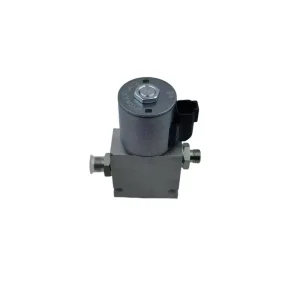
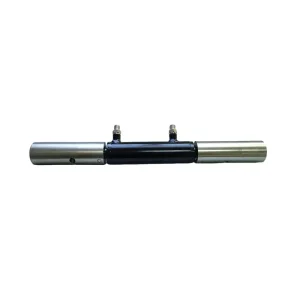
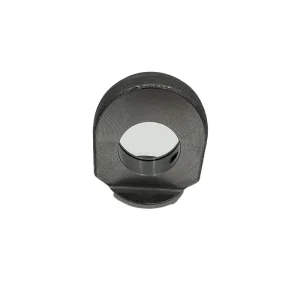
Browse our comprehensive selection of differential lock solenoids, telescopic multi-stage cylinders, retention knobs, and heavy-duty bucket linkages.