
Featured Hydraulic Actuators & Machined Components
Engineered for high-stress hydraulic steering, positioning, and workholding operations under rigorous operating conditions.
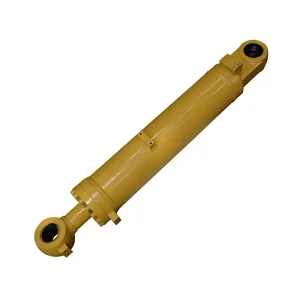
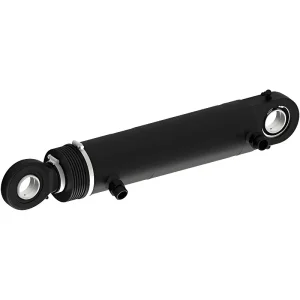
Global Commercial & Industrial Status of Power Steering Actuators
As off-highway mobile equipment advances toward higher payload capacities, autonomy, and electro-hydraulic hybrid systems, power steering cylinders must deliver zero-drift kinematic precision and extreme fatigue resistance.
Critical Safety Mandate
Unlike implement cylinders (such as excavator bucket cylinders or tilt rams), a power steering cylinder is a designated primary vehicle safety component under ISO 5010 and ISO 10998. Hydraulic fluid bypass, valve stiction, or mechanical seal extrusion can cause instantaneous directional control failure. OEMs require fail-safe sealing systems, dual mechanical lock rings, and integrated counter-balance or pilot-operated relief valves.
Electro-Hydraulic & Steer-by-Wire Integration
The global paradigm is shifting rapidly from purely hydrostatic orbitrol units to electro-hydraulic steering (EHS) and fully steer-by-wire (SbW) architectures. Smart steering actuators integrate contactless magnetostrictive linear position transducers directly into the hollow gun-drilled cylinder rod, providing sub-millimeter positional feedback for autonomous tractor GPS autosteer and ADAS features.
Extreme Environmental Resilience
Steering cylinders are mounted directly on oscillating steering axles, exposed to stone strikes, aggressive chemical deicers, slurry, and high salt-fog conditions. Tier-1 manufacturers require induction-hardened chrome-plated rods achieving over 1,000 hours of neutral salt spray testing (ASTM B117 Rating 10) and operating smoothly from sub-zero arctic climates (-40°C) to desert heat (+105°C).
Engineering Architecture & Precision Sourcing Specifications
Understanding the structural differences between balanced equal-displacement actuators, differential single-rod steering cylinders, and heavy tandem axle steer rams.
Kinematic Cylinder Configurations
Power steering cylinders generally fall into three structural typologies depending on chassis space and steering axle steering geometry:
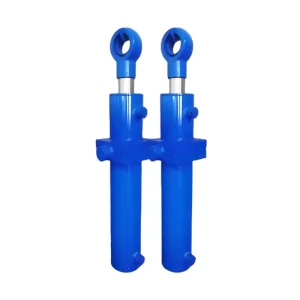
- Double-Acting Balanced (Equal-Area) Cylinders: Featuring a continuous double-ended rod where effective piston area is identical on both stroke directions. This provides uniform volumetric displacement and equal steering turns from lock-to-lock without hydraulic asymmetry. Widely deployed in high-capacity front-wheel steering axles.
- Differential Single-Rod Cylinders (Paired Configuration): Utilized in push-pull tandem pairs mechanically linked across the kingpins or articulation joints. Fluid output from the rod end of cylinder A feeds into the bore end of cylinder B to maintain balanced flow rates.
- Direct Integrated Steering Axle Cylinders: Built directly into the axle casing with welded cast brackets and integrated spherical bearings to resist tremendous side-load forces generated when turning heavy tires over soft or rocky terrain.
Advanced Seal & Metallurgical Topology
Dynamic life expectancy exceeds 2,500,000 steering cycles through meticulous material specification:
- Cylinder Barrel: Cold-drawn seamless ST52.3 / E355 DIN EN 10305-1 tubes, precision skived and roller burnished to an internal surface roughness of Ra ≤ 0.15 μm, eliminating micro-pitting and seal abrasion.
- Piston Rod: 42CrMo4 / 40Cr alloy steel, precision ground to f7 tolerance, high-frequency induction hardened to 54–60 HRC (case depth 1.5–3.0 mm), followed by double-layer hard chrome plating (25–50 μm) for anti-flaking durability.
- Sealing System: Proprietary bronze-filled PTFE step seals paired with nitrile or FKM energizers, accompanied by heavy-duty polyoxymethylene (POM) guide rings and dual-lip metal-cased polyurethane dust wipers that repel mud and sand.
| Engineering Parameter | Standard Commercial Duty | Heavy-Duty Off-Highway (OEM Spec) | Mining & Severe Articulated Duty |
|---|---|---|---|
| Nominal Working Pressure | 160 – 210 Bar (16 – 21 MPa) | 250 – 280 Bar (25 – 28 MPa) | 350 – 420 Bar (35 – 42 MPa) |
| Bore Diameter Range | Ø 40 mm – Ø 80 mm | Ø 70 mm – Ø 140 mm | Ø 120 mm – Ø 250 mm |
| Rod Material & Hardness | CK45 / 1045; 20–25 HRC | 40Cr / 42CrMo4; 54–60 HRC Inducted | 42CrMo4 Quenched & Tempered; 58–62 HRC |
| Plating & Corrosion Standard | 20 μm Chrome; 480h Salt Spray (NSS) | 30 μm Hard Chrome; 1,000h NSS ISO 9227 | Nickel-Chrome or QPQ; 1,500h+ Severe Corrosive |
| Fluid Cleanliness Tolerance | ISO 4406 19/17/14 | ISO 4406 17/15/12 | ISO 4406 16/14/11 (NAS 1638 Class 5) |
| Operating Temperature | -25°C to +80°C | -35°C to +100°C (Low-temp NBR) | -45°C to +125°C (Viton / Polyurethane) |
Why Tier-1 Global Procurement Teams Source from Qingdao, China
Combining world-class CNC precision, regional steel casting clusters, and direct maritime container ports to establish a sustainable total-cost-of-ownership (TCO) advantage.
Vertical In-House Manufacturing
At Qingdao Micro Precision Machinery (MPM, Est. 2006), we eliminate multi-tier subcontractor markups. From rough forging and raw bar procurement to deep-hole boring, CNC skiving, multi-axis milling of valve manifold ports, robotic weld fabrication, and induction heat-treatment, 100% of core operations remain within our certified 3,500 m² production facilities in Chengyang, Qingdao.
Rapid Prototyping & DFM Flexibility
European and North American hydraulic foundries often require 16 to 24 weeks of engineering lead time for custom tooling and initial casting validation. Our engineering cell accelerates Design for Manufacturability (DFM) reviews to under 48 hours. First-article samples (FAS) and functional prototypes for OEM trial-fit testing are routinely delivered within 21–28 calendar days.
Immediate Coastal Logistics Access
Positioned less than 35 kilometers from Qingdao Port—one of the world's five largest container hubs—we provide seamless FCL, LCL, and air cargo connectivity. International consignments clear customs without inland transit demurrage, lowering logistics overheads by 12–18% compared to landlocked industrial producers, with direct sailings to Hamburg, Rotterdam, Long Beach, and Santos.
Specialized Industry Use-Cases & Field Demands
From subterranean mining tunnels to vast agricultural fields, power steering cylinders must be customized for exact dynamic duty cycles.
Heavy Wheel Loaders & ADTs
Articulated Dump Trucks (ADTs) and articulated wheel loaders rely exclusively on dual steering cylinders to pivot the entire chassis front-to-rear. These cylinders experience brutal shock forces when wheels strike rocks.
- Dual-end hydraulic cushioning
- Direct manifold counterbalance valves
- Heavy-duty forged spherical eyes
Modern Agricultural Tractors
High-horsepower farm tractors and self-propelled sprayers require balanced steering cylinders integrated with steer-by-wire and RTK GPS guidance for autonomous plowing and planting with centimeter-level precision.
- Low-friction PTFE step seals
- Embedded linear position sensors
- Corrosion resistance against fertilizers
Industrial Material Handling
Counterbalance forklifts and reach stackers operating in logistics hubs demand compact, continuous double-rod steering cylinders capable of achieving rapid lock-to-lock maneuverability in tight warehouse aisles.
- Zero internal bypass guarantee
- Compact barrel footprint
- Over 20,000 continuous hours life
Underground Mining LHDs
Subterranean Load-Haul-Dump (LHD) equipment operates in narrow, unventilated tunnels laden with acidic mine water and abrasive quartzite dust. Cylinders require impervious armor plating and specialized seals.
- Laser-clad stainless or nickel-chrome rods
- Severe-duty wiper scrapers
- Explosion-proof fluid compatibility
Emerging Trends Reshaping OEM Steering Hydraulics
The convergence of digital hydraulic controls, eco-compatible fluids, and predictive maintenance telemetry is transforming basic actuators into smart cyber-mechanical subsystems.
Smart Sensory Telemetry
Global OEMs are rapidly abandoning external steering angle potentiometers, which are prone to mechanical impact damage. Next-generation cylinders feature internally mounted, high-pressure absolute magnetostrictive sensors that continuously stream real-time stroke data directly to the vehicle CAN-bus (J1939), facilitating fault detection and autonomous steering control.
Bio-Hydraulic & Low-Friction Tribology
With stringent environmental regulations across Europe and North America (such as the EU Ecolabel and US EPA VGP), agricultural and forestry OEMs increasingly specify biodegradable ester-based synthetic hydraulic fluids (HEES/HETG). We utilize specialized polyurethane and fluorocarbon formulations resistant to fluid hydrolysis and seal breakdown at elevated temperatures.
Weight Optimization & FEA Topology
As electric battery-powered mobile machinery (e-mobility) expands, vehicle weight reduction becomes paramount. Using finite element analysis (FEA) and high-yield alloy steels (700+ MPa tensile strength), cylinder barrel wall thicknesses and end-clevis forgings are structurally optimized to trim dead weight by up to 22% without sacrificing fatigue limits.
Strict Quality Verification & Procurement Roadmap
Our 5-stage quality governance model guarantees that every steering cylinder arriving at your assembly line integrates flawlessly without on-site rework.
Metallurgical Inspec
100% optical emission spectrometer chemical analysis and ultrasonic non-destructive testing (NDT) of all seamless raw tubes and rod billets before machining begins.
Precision CNC Machining
Multi-axis CNC turn-mill execution holding thread tolerances to ISO 6H, rod runouts under 0.02 mm, and micro-honed barrel concentricity throughout the batch.
Ultrasonic Decontamination
Automated multi-stage ultrasonic degreasing and robotic particulate flushing ensuring hydraulic cleanliness exceeding ISO 4406 17/15/12 standards.
1.5x Proof Hydro-Testing
Every single completed steering cylinder is tested at 150% rated working pressure across full strokes with computerized transducer-logged leak detection.
Export Protective Barrier
VCI anti-corrosion inner wrap, nitrogen pre-charging on request, thread port protection caps, and heavy-duty ISPM-15 heat-treated export crating for sea transit.
Frequently Asked Questions by Global Hydraulic Procurement Engineers
In-depth technical answers regarding tolerances, fluid compatibility, custom OEM configurations, and supply contracts.
What causes hydraulic steering cylinder drift and how does your factory prevent it?
Steering cylinder drift (unintended vehicle wandering when operating in a straight line) is primarily caused by internal fluid bypassing across the piston seals, micro-porosity in cast heads, or internal valve leakage. We eradicate this failure mode by precision skiving cylinder barrels to Ra ≤ 0.15 μm, utilizing high-modulus bronze-filled PTFE step seals backed by 85-shore NBR/FKM energizers that prevent dynamic extrusion, and conducting 100% full-stroke pressure decay testing under closed ports for zero acceptable drop over holding cycles.
Can you reverse-engineer or customize an obsolete OEM steering cylinder from an existing physical sample?
Yes. Our Qingdao engineering facility features optical 3D coordinate measuring machines (CMM), surface profilometers, and metallographic spectrometer equipment. Simply courier a worn or obsolete unit to our plant. Our engineers disassemble the cylinder, map pin-to-pin mounting centerlines, determine rod and barrel metallurgy, measure seal gland profiles, and generate an approved 2D/3D CAD drawing packet before initiating CNC production.
What international manufacturing and thread tolerance standards does your machinery adhere to?
We machine parts precisely to customer-supplied imperial or metric drawings. Standard configurations follow ISO 6H thread class for locknuts and gland retainers, DIN 3852-2 / SAE J1926 O-ring boss or flat-face O-ring ports, and DIN 69872 / JIS B6339 machining center tooling interfaces. Weldments meet ISO 5817 Level B standards with comprehensive ultrasonic and magnetic particle crack examination.
How do you protect piston rods from aggressive pitting and salt corrosion in marine, port, or deicing environments?
Standard cylinders receive 25–35 μm of micro-cracked hard chrome over high-frequency induction-hardened alloy steel, passing 500 to 1,000 hours of neutral salt spray testing (ISO 9227 NSS). For marine environments, coastal port equipment, and chemical deicer exposure, we supply double-layer chrome (nickel underplate + hard chrome) or nitrocarburizing (QPQ / Tenifer) yielding 1,500+ hours of ASTM B117 salt spray endurance without microscopic corrosion breakdown.
What documentation and inspection certifications accompany international export shipments?
Every production batch includes an EN 10204 3.1 Material Test Report (MTR) detailing chemical heat analysis and mechanical tensile testing, Dimensional CMM Inspection Sheets, Heat-Treatment Hardness Verification, Pressure Test Certificates with recorded hydro-decay curves, and Certificate of Origin (CO/Form A/RCEP) for streamlined tariff clearance.
What are your standard Minimum Order Quantities (MOQ) and lead times for prototype versus series production?
For custom OEM development, we support prototyping orders with an MOQ as low as 1 to 5 units for fit-up and machine qualification. Following prototype sign-off, series production runs are scheduled with flexible batch volumes ranging from 50 to 2,000 units per month. Prototype lead times are generally 20–30 days; repeat mass-production orders are completed in 30–45 days.
Comprehensive Hydraulic Parts, Tooling & Actuator Selection
Explore our complete industrial portfolio manufactured to international ISO, DIN, and JIS performance benchmarks.
Initiate Your Power Steering Cylinder RFQ
Send your bore, rod, stroke, and mounting drawings. Our engineering team provides DFM reviews and detailed quotations within 24 hours.