
China Top 10 Cylinder End Manufacturers for Global Buyers offers a practical starting point for sourcing pressure-vessel components. These manufacturers may produce dished, hemispherical, elliptical, and torispherical ends for chemical, energy, food-processing, and storage applications. The right supplier should provide more than attractive pricing. Buyers need traceable steel, controlled forming, qualified welding, accurate dimensions, and dependable inspection records.
Details decide outcomes. A small mismatch at the nozzle opening can delay assembly. Uneven wall thickness may affect service performance. Serious evaluations should examine material certificates, heat-treatment records, ultrasonic testing, radiographic testing, hydrostatic-test procedures, and final dimensional reports. Standards such as ASME Section VIII, EN 13445, and applicable PED requirements may also matter, depending on the destination market. ISO 9001 certification is useful, but it does not replace a factory audit.
Manufacturing quality authority W. Edwards Deming said, “Quality comes not from inspection, but from the improvement of the production process.” That principle fits Cylinder End purchasing well. Reliable suppliers build quality into cutting, pressing, spinning, welding, and inspection stages. Buyers should also review production capacity, tooling limits, export packaging, communication speed, and after-sales support.
A ranking is never perfect. One factory may excel at stainless steel while another handles large carbon-steel heads better. Some suppliers present impressive catalogs but provide limited evidence. This guide therefore emphasizes verifiable capabilities, documented quality practices, and practical buyer experience. The strongest choice is not always the cheapest one. It is the manufacturer that can repeatedly deliver the specified Cylinder End, with clear records and fewer surprises.
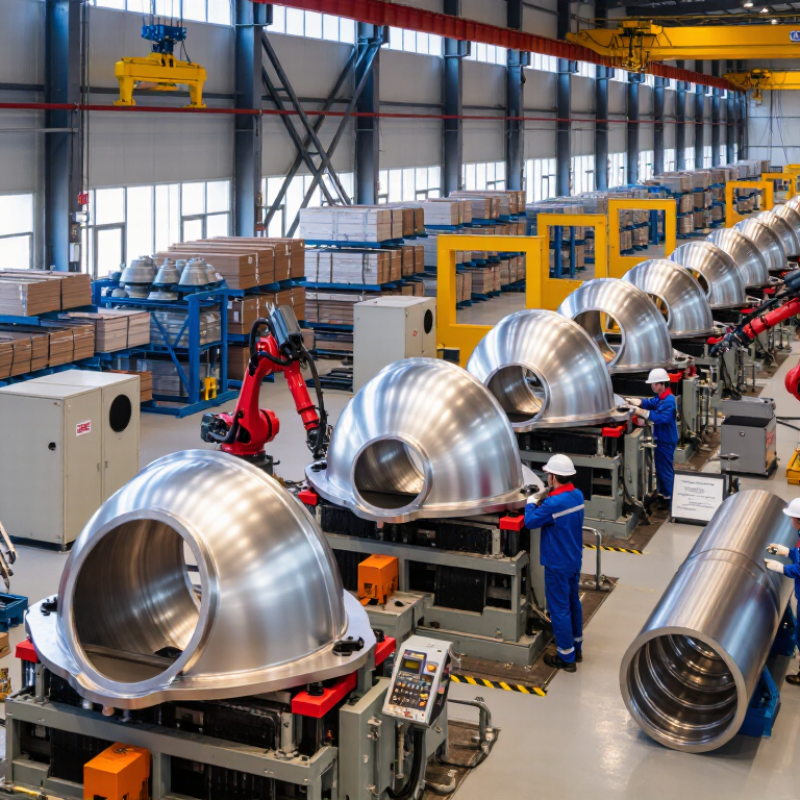
Cylinder ends are the closure components fitted at both sides of a hydraulic or pneumatic cylinder. They are not simple metal covers. A cylinder head guides the piston rod, supports seals, and often carries the gland or wiper. The rear cap contains pressure, connects to the barrel, and may include a mounting eye or threaded port. At 200 bar, a small machining error can cause leakage, uneven rod movement, or premature seal wear.
Global buyers need cylinder ends because these parts affect safety, service life, and interchangeability. Materials commonly include ductile iron, carbon steel, stainless steel, or aluminum, depending on pressure, corrosion, and operating temperature. Proper suppliers should provide dimensional inspection, material certificates, surface-finish records, and traceable batch information. ISO 6020/2 and ISO 15552 offer useful dimensional references for many industrial cylinder designs, but a standard does not replace application testing.
A 2024 hydraulic-cylinder market assessment by Grand View Research estimated the global market at about USD 14.7 billion in 2023, with continued growth expected through 2030. This expansion increases demand for reliable replacement and custom components. Yet market growth can hide a practical problem: buyers sometimes compare only price and thread size. That is insufficient. Port geometry, seal grooves, concentricity, fatigue performance, and heat treatment also matter. Even experienced teams can miss one tolerance. A careful manufacturer therefore reviews drawings, pressure cycles, corrosion exposure, and assembly methods before production.
Choosing among China’s top 10 cylinder end manufacturers requires more than comparing catalog prices. Evaluate machining accuracy, material control, and production consistency. Ask for drawings, tolerance records, and material certificates for each cylinder end. A reliable manufacturer should explain steel grades, heat treatment, thread standards, and surface protection clearly. Vague answers deserve caution.
Request a sample before signing a large order. Measure thread depth, sealing surfaces, concentricity, and mounting dimensions with calibrated tools. Review pressure-test procedures and inspection reports, not only product photographs. A factory audit can reveal practical details, such as clean workstations, labeled batches, and protected finished parts. Confirm traceability from raw material receipt to final packing. Delivery promises also need evidence. Check recent production capacity, packaging methods, and export documentation.
Tips: Compare at least three suppliers using the same technical checklist. Ask how they handle nonconforming parts and replacement claims. Put approved samples, inspection standards, and tolerances into the contract. Keep communication written. Small misunderstandings can become expensive machining changes. A polished factory tour is useful, but it is not proof of long-term reliability. I have seen evaluations focus too heavily on price and overlook inspection discipline. That is a mistake worth reconsidering. Also, do not assume every certificate applies to your exact cylinder end; verify its scope, issuing body, and validity.
China Top 10 Cylinder End Manufacturers for Global Buyers
China’s top ten cylinder end manufacturers stand apart through specific production strengths, not simple sales claims. This ranking considers material control, machining accuracy, pressure testing, customization, and export experience. One leading group focuses on forged carbon steel ends for heavy hydraulic cylinders. Another specializes in stainless steel components for damp, chemical, and outdoor environments. Their production records should include heat-treatment data and traceable inspection reports.
Several manufacturers serve demanding custom projects. One uses advanced CNC turning for tight threads and consistent sealing surfaces. Another supports small batches, helping buyers test new equipment without excessive inventory. A separate specialist produces high-pressure cylinder ends, where surface finish and thread geometry require strict control. Pneumatic applications are covered by manufacturers skilled in lightweight aluminum and compact designs. Some factories also provide corrosion-resistant coatings, while others combine machining, welding, and final assembly under one roof.
Details matter. Ask for dimensional reports.
The strongest export-oriented suppliers usually maintain clear packaging procedures, batch numbers, and multilingual technical documents. They may understand international purchasing routines, but communication can still fail when drawings lack tolerances. This is an overlooked weakness. Buyers should confirm pressure ratings, thread standards, raw material certificates, and sample approval before placing volume orders. A manufacturer with reliable testing equipment is often safer than one offering the lowest quotation. Supplier rankings can change as capacity, quality systems, and customer support develop.
China Top 10 Cylinder End Manufacturers for Global Buyers
For global buyers, comparing China’s top 10 cylinder end manufacturers requires more than a price table. Quality starts with controlled materials, stable machining, and clear inspection records. In supplier audits, I check steel certificates, dimensional reports, and surface-finish readings. Small errors around threads or sealing grooves can cause serious assembly problems. They are easy to miss. A capable factory should explain its tolerances, sampling plan, and corrective actions without vague promises.
Certification also needs careful reading. ISO 9001 shows that a quality system exists, but it does not guarantee every component is perfect. Pressure-related products may require additional compliance, depending on the application and destination market. Buyers should verify certificate scope, issuing bodies, expiration dates, and product coverage. A copied document is not evidence. Ask for traceability from raw material batch to final inspection.
Customization separates a flexible manufacturer from a catalog supplier. Confirm port position, thread type, mounting pattern, material grade, coating, and operating temperature. Request a controlled drawing before production. For repeat orders, review first-article samples and change-control procedures. Packaging matters too; damaged sealing surfaces can ruin good machining. I have seen suppliers meet drawings but miss practical installation details. That deserves honest discussion, not a rushed approval. Video inspections, independent testing, and a written acceptance standard can reduce uncertainty before shipment.
| No. | Comparison Area | Buyer- Verifiable Requirement | Applicable Standard or Reference | Recommended Evidence | Customization Indicator |
|---|---|---|---|---|---|
| 01 | Material Traceability | The supplier should identify the material grade, heat number, incoming inspection status, and production batch for each cylinder end component. | EN 10204 Type 3.1 inspection certificate; ASTM material specifications where applicable. | Material certificate, heat-number record, and batch-level traceability report. | High: alternative steel, stainless steel, or aluminum grades can be reviewed before production. |
| 02 | Dimensional Accuracy | Critical bores, threads, sealing grooves, mounting faces, and concentricity should be controlled against an approved engineering drawing. | ISO 2768 for general tolerances when specified; customer drawing tolerances take priority. | Dimensional inspection report, calibrated measuring equipment list, and first-article inspection record. | High: custom tolerances, port locations, mounting patterns, and interfaces. |
| 03 | Pressure and Leak Testing | Pressure-containing cylinder ends should be tested using a documented procedure suitable for the design pressure, fluid, and assembly configuration. | ISO 10100 for hydraulic cylinders; ISO 4414 or ISO 4413 principles where applicable to pneumatic or hydraulic systems. | Hydrostatic or pneumatic test record, leak-test result, test pressure, holding time, and acceptance criteria. | High: test pressure, test medium, ports, and reporting format can be specified. |
| 04 | Quality Management System | Production, inspection, corrective action, document control, and supplier evaluation should operate under a controlled quality system. | ISO 9001:2015 certification from an appropriately accredited certification body. | Valid certificate, scope of certification, expiry date, and certification-body verification. | Medium: quality procedures can be aligned with customer-specific inspection plans. |
| 05 | Surface Protection | The selected coating or treatment should match the operating environment, corrosion exposure, storage period, and contact with hydraulic fluid. | ISO 12944 for corrosion-protection environments; coating-specific technical data should also be reviewed. | Coating specification, surface-preparation record, coating-thickness report, and salt-spray data where required. | High: zinc plating, phosphate treatment, paint systems, anodizing, or customer-specified finishes. |
| 06 | Regulatory Compliance | The buyer should confirm whether the complete assembly falls within pressure-equipment, machinery, export, or chemical-compliance requirements. | EU Pressure Equipment Directive 2014/68/EU when its scope and classification apply; RoHS and REACH may apply to relevant products and markets. | Declaration of conformity, technical file support, material declarations, and market-specific compliance documents. | Medium: documentation and component selection can be adapted to destination-market requirements. |
| 07 | Machining and Joining Capability | Manufacturing resources should cover CNC turning, milling, threading, sealing-groove machining, and qualified joining processes when welded construction is used. | ISO 3834 for quality requirements in fusion welding; ISO 15614-1 for welding procedure qualification where applicable. | Machine capability list, welding procedure specification, welder qualification, and process-control records. | High: one-piece machined, welded, forged, or assembled designs can be evaluated. |
| 08 | Sealing and Compatibility | Seal materials, groove geometry, surface finish, and fluid compatibility should be selected according to temperature, pressure, speed, and media. | ISO 3601 for O-rings where applicable; manufacturer seal data must confirm chemical and temperature compatibility. | Seal material certificate, compatibility chart, groove inspection report, and installation specification. | High: seal compounds, backup rings, groove profiles, and service-temperature ranges. |
| 09 | Prototype and Production Control | A reliable supplier should control drawing revision, sample approval, process validation, inspection frequency, nonconforming products, and change management. | ISO 9001 production-control principles; PPAP or first-article procedures may be requested by the buyer. | Approved drawing, control plan, first-article report, process-flow chart, and change-notification procedure. | High: prototypes, pilot batches, and staged production approvals. |
| 10 | Packaging and Export Readiness | Finished cylinder ends should be protected from corrosion, impact, contamination, and moisture during international transport and storage. | ISPM 15 for regulated wood packaging materials; buyer-specific export packaging instructions should be documented. | Packaging specification, preservation method, packing list, country-of-origin documentation, and shipping inspection photos. | Medium to High: neutral packaging, barcode labels, pallet standards, and export documentation. |
Note: This buyer comparison matrix uses internationally recognized standards and verification documents. Actual certification, tolerances, testing, and customization capability should be confirmed from the individual supplier’s current documentation and approved technical drawings.
China Top 10 Cylinder End Manufacturers for Global Buyers
Selecting among China’s top ten cylinder end manufacturers requires more than comparing prices. Start with the end-use standard, design pressure, steel grade, wall thickness, and forming method. Ask each supplier for recent material certificates, heat numbers, dimensional inspection records, and non-destructive testing results. ASME BPVC Section VIII, EN 13445, or applicable national standards should appear clearly in the technical specification. Vague compliance statements are warning signs.
The ISO Survey 2023 recorded more than 1.26 million ISO 9001 certificates worldwide. Certification helps, but it does not prove consistent cylinder end quality. Audit the factory’s forging, hot spinning, machining, heat-treatment, and inspection areas. Check whether operators can trace one finished part back to its billet and furnace record. Request samples with measured crown height, bore diameter, concentricity, and hardness. Small deviations can create welding problems later.
Purchase terms deserve equal attention. Define inspection points before production, including witness testing, packaging, marking, and replacement procedures. The supplier should explain lead times using capacity data, not optimistic promises. Confirm export documents, pallet protection, moisture control, and insurance responsibilities. A low quotation may hide tooling, testing, or port charges. I still distrust audits based only on photographs. A live video review is useful, but an independent pre-shipment inspection is stronger. Some buyers also overlook currency risk and payment exposure. That mistake can be expensive.
Compare machining accuracy, material control, pressure testing, customization, and export experience. Price alone is weak evidence.
Request technical drawings, tolerance records, material certificates, heat-treatment data, and inspection reports. Check each document’s scope and validity.
A sample reveals thread depth, sealing quality, concentricity, and mounting dimensions before volume production. Measure it with calibrated tools.
Look for clean workstations, labeled batches, protected finished parts, and practical inspection routines. A polished tour proves little.
Ask about steel grades, raw material certificates, and heat-treatment procedures. Confirm traceability from receipt to final packing.
Review pressure-test methods, test limits, equipment condition, and related inspection reports. Photographs are not enough.
Use one technical checklist for at least three suppliers. Compare tolerances, packaging, capacity, documentation, and claim handling.
Include approved samples, thread standards, tolerances, inspection rules, replacement procedures, and packaging requirements. Keep communication written.
Check recent production capacity, batch control, packaging methods, and export documentation. Delivery promises need evidence.
Not necessarily. Inspection discipline and consistent machining may matter more than the cheapest offer. I may overvalue price sometimes. That deserves reconsideration.
This guide explains what a Cylinder End is, how it supports the performance and safety of hydraulic or pneumatic cylinders, and why it matters to global buyers seeking reliable industrial components. It outlines the main factors for evaluating Chinese manufacturers, including production capability, material selection, machining accuracy, engineering support, delivery consistency, and communication. The article also compares ten manufacturers by core strengths such as customization, large-scale production, precision processing, application expertise, and export service.
Buyers will learn how to compare quality systems, inspection procedures, certifications, testing standards, surface treatments, dimensional tolerances, and customization options. The guide concludes with a practical supplier-selection and purchasing process: define technical requirements, review drawings and samples, verify manufacturing capacity, request clear quotations, confirm quality controls and lead times, and establish suitable after-sales support. This approach helps international purchasers choose a dependable Cylinder End supplier while balancing performance, cost, compliance, and long-term cooperation.
